
Essays

Mr. Lovecraft Goes to China

Nick Stember delves into H.P. Lovecraft’s legacy, and a new Chinese collection inspired by it

Long a loomingly tenebrous presence in American pop culture, it was perhaps only a matter of time before the disturbing specter of H.P. Lovecraft slithered into Chinese. While the definitive history of Lovecraftian sino-fic remains to be written, Camphor Press’ new collection of Chinese short stories inspired by Lovecraft, The Flock of Ba-Hui and Other Stories, may well be the first to survived the journey into English, thanks to translators Arthur Meursault and Akira.

Although Lovecraft’s work had found its way into Chinese as early as 2005 with a translation of August Derleth’s classic 1969 collection Tales of the Cthulhu Mythos (credited to Hu Jianhong and Yu Yunling, published by Harbin Press under the title Myths of Lovecraft: Return of the Evil Gods), this particular iteration would seem to trace it’s eldritch origins back to late 2007, in the heady days before the bacchanal of the Beijing Olympics. On (one would imagine) a dark and stormy night of December 5, 2007, a subforum dedicated to the bestselling tabletop roleplaying game Call of Cthulhu (CoC) was launched on The Ring of Wonder (TROW), an online community for Chinese (and Chinese-speaking) fans of fantasy gaming, roleplaying and fiction.

Reviews

A Map of Shanghai’s Neglected Crannies

Kevin McGeary reviews a new story collection, The Book of Shanghai

In 2019, the Globe and Mail published an op-ed titled ‘Welcome to Shanghai: Capital of the Future.’ In it, the author describes his experience of visiting the city as like “walking through the looking glass into the future.” Citing the city’s “muscular” building strategy, colossal scale, citizens’ entrepreneurial energy, and (of course) China’s ancient history, much of the article would not have been out of place in The Global Times. While he says London and New York are “the world’s current leading cities,” some of his arguments as to why Shanghai is primed to overtake them are strong.

Yet fiction leaves more room for exploring the conflict between how a city sees itself and how the world sees it. At its best, literature can capture both the appealing and the abhorrent aspects of a particular time and place. As editor Jin Li mentions in his introduction to a new collection of fiction based in the city, The Book of Shanghai, unlike Beijing, Xi’an or nearby Hangzhou, Shanghai did not become a major city until after the first Opium War when the colonial powers used it as a port. From its hey-day in the 1920s, Shanghai was an important hub through which an ancient culture entered the modern world.

Translation

Hooking Up Under Lockdown

A personal essay by Fan Popo, translated by Allen Young

Not long ago, a heartwarming story appeared on the blog Humans of New York: anxiously awaiting his Covid-19 test results, a young man opened Grindr and shared his fears with a retired doctor he’d met. The two had no intimate contact, yet the older gentleman offered more than a shoulder to cry on: he brought over quarantine supplies and left them at the young man’s door.

The post got hundreds of thousands of likes on Facebook, maybe because people are especially in need of this kind of positive energy right now. Turns out that Grindr – a hookup app – can be used in diverse and innocent ways. You have to wonder, though: did those two really open the app just out of a desire to chat? Life under lockdown has heightened our sexual anxieties. In a world of social distancing, has the carefree hookup become just another fantasy?

The mood of panic inevitably calls to mind the AIDS fears of the 1980s, when gay men in the US and Europe began to regard each other with suspicion. The crisis left such a deep stigma that virtually the entire community has some connection to it, from the daddies who lived through it to the twinks and cubs who are just coming onto the scene.

Essays

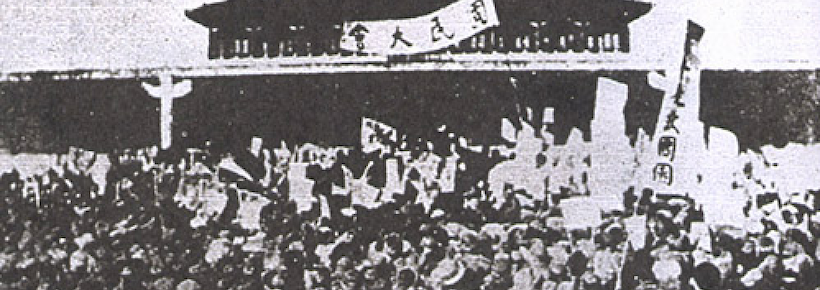
May the 4th Spirit Be With You

The enduring, eroded legacy of youth protest in China – Alec Ash

On September 15th 1915, the intellectual Chen Duxiu wrote a paean to the youth of China, for the opening essay of a revolutionary magazine he had founded:

“Youth are like the early spring, like the morning sun, like the blooming grass, like the sharp blade fresh off the grinding stone; youth is the most valuable time of life.”

Titled ‘Advice for Youth,’ Chen’s essay lauds young Chinese who oppose the nation’s status quo as “fresh, vigorous cells inside the human body,” where the old guard are “rotten, corrupted cells.” In this metabolism of society, fresh cells must “vigourously drive out” the rotten. If “their blade is sharp enough to cut iron and hemp, and they don’t follow other’s lead or hesitate in thought,” he exhorts, then “maybe society will arrive at a peaceful day.”

Bangdong

How Tea Transformed China’s Countryside

An ancient legacy of tea trading is reinvented for the 21st century – Matt Chitwood

Deep in the mountains of southwestern China, where tea was likely first discovered, a trail begins. Over the course of a thousand years, it has been carved step-by-step through some of the world’s most diverse and rugged terrain, traversing the lush tropical forests of what is now Yunnan province – a botanist’s playground – and up into the Himalayas, through treacherous river gorges and snowy mountain passes. The carving was done by mabang, trade caravans comprised of humans, horses, mules and yaks that carried daily necessities such as salt, sugar and medicines as well as luxuries like textiles and cigarettes. But most important, they carried tea. 

Compressed for easier transport, it was a vital source of nutrition for those living in the harsh climate of the Tibetan plateau. For tea-producing regions, it was a critical means of obtaining Tibetan warhorses that would help distant dynasties administer their borderlands. For both regions, it was the centerpiece of social interaction. Tea begat trust and trust begat trade: the virtuous cycle which built the route we know today as the Ancient Tea Horse Road. In fact, it was more a network of trails than a single road. Its branches diverged and converged, even extending down to Southeast Asia and west to Nepal and India. It remained a lifeline across the region well into the mid-20th century until the advent of motor vehicles led to its disuse and disrepair.