Dispatches

Tracing the Yunnan-Vietnam Railway

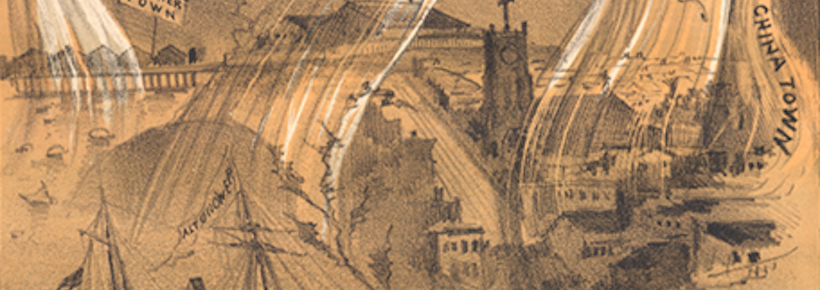
Looking back down the tracks at French Indochina’s legacy in southeast Yunnan – Thomas Bird

The Map of the Current Situation dating back to 1898 hangs in the halls of Yunnan Railway Museum. It depicts the Qing Empire encroached upon by a bulldog with a lion’s body, an eagle swooping across from The Philippines, a grizzly bear stopping through Manchuria and a frog sliming its way up from Southeast Asia. These invasive species represent Britain, the USA, Russia and France respectively, while Japan looks on from the side lines, a jealous rising sun holding a leash around Taiwan’s neck.

With a population numbed by opium and ruled by aloof Manchu royals hauled up in their Beijing citadel, turn-of-the-century China made easy-pickings for hungry colonial powers who began to slice old Cathay up like a birthday cake.

Most of the competing powers constructed railways, which served to open up the economy in a realm with few good roads. But beyond its practical functions, the railway also acted as a territorial marker, an agent of empire, provoking historians to coin the term “railway imperialism”. Russian tracks laid a cross through Manchuria, expressing the Tsar’s clandestine plans to dominate in the Northeast. Germany built a large section of the north-to-south Jinpu Railway through its sphere of interest in Shandong with Great Britain building the rest. In fact, Britain was perhaps busiest of all, constructing the KCR line in cooperation with Chinese engineers through the Pearl River Delta as well as the Imperial Chinese Railway from Beijing to Mukden (Shenyang).

Dispatches

A Steam Train to 1950s China

Ben Kletzer rides China’s last steam train, built during the Great Leap Forward

Far away from the dense urban centers of coastal China, daily life in Bajiaogou, a rural township in Sichuan province, was marked by the four-times daily arrival of one of the last surviving steam trains in the world. The little railway was the lifeline of this picturesque mountain village; transporting everything for the villagers, passengers and mail, livestock and building materials.

I first visited Bajiaogou in 2011 to see this steam train, known as the Bashi Railway for its two terminals, Bajiaogou and Shixi. Many foreign train enthusiasts have ridden or photographed the Bashi steam train. Their online reports describe an isolated, scenic railway. I set off from Chengdu, taking an aging bus south to the city of Qianwei, where I took a short ferry across the Minjiang river to Shixi, the other terminus of the railway. After purchasing a ticket for 1.5 yuan, I boarded the ramshackle coaches, squeezing onto a crowded wooden bench seat.

Essays

‘The Truth is the Most Effective Vaccine’

How the coronavirus pandemic exposes the suppression of information in China, and the real people’s war – Joan Judge

As the coronavirus pandemic escalates globally, and as we grapple with the missteps of our own leadership in the Western world, some are echoing the World Health Organization’s praise of the Wuhan lockdown as a model for the planet. At such a moment it is imperative to bear in mind the human cost of China’s belated and aggressive approach to the outbreak: both loss of life and the brutal repression of public-minded critique.

President Xi Jinping has declared this approach a “People’s War.” Desperate to deflect percolating anger and frustration over the local government’s delayed response to the virus, the central government’s subsequent draconian policies, and the over 3000 (recorded) deaths, Xi unimaginatively turned to familiar tactics of Maoist mass mobilization. Official media have glorified heroic medical personnel in the spirit of labor models of the 1950s and 1960s. They have gone so far as to post a video of a team of female medics having their heads shaved as they selflessly prepared to serve at the virus’s epicenter. Slogans are ubiquitous, galvanizing people to fight the People’s War by altering their behavior. “Those who gather together are shameless;” banners warn, “those who play mahjong are daredevils.”

Little Red Podcast

Viral Disruption

How the Covid pandemic is rewriting the global order

An episode of the Little Red Podcast

COVID-19 isn't just destroying economies, it's also reshaping the global order.  In less than a month, the novel coronavirus has moved from being China's Chernobyl to being an advertisement for China’s brand of governance. As Western governments, in particular the US, fail to grapple with this enormous public health challenge, China is presenting itself as the world’s saviour.  Beijing's multipronged approach includes using facemask diplomacy donating medical equipment to the West, while its diplomats try to sow doubt about whether the outbreak began in Wuhan. To discuss the geopolitics of COVID-19 against the backdrop of deteriorating US-China relations, we’re joined by Ian Bremmer, president and founder of the political risk consulting firm Eurasia Group and G-ZERO Media, and host of the podcast “GZERO World with Ian Bremmer”, as well as Bill Bishop, the founder of the Sinocism China newsletter, and Simon Rabinovitch, the Economist’s Shanghai-based correspondent:

Essays

How Anti-Chinese Sentiment During Covid-19 Draws on America’s Racist History

Trump’s “Chinese Virus” comments play up to xenophobic tropes – Elizabeth M. Lynch

Donna Chiu has dedicated most of her life to fighting for vulnerable New Yorkers. A petite, Chinese-American woman with a quick smile and contagious laugh, you would never think she would be able to take on some of New York City’s sleaziest landlords. But within the dark, dingy halls of New York City’s housing courts, she transforms into a pit bull, fighting for her clients, low-income tenants, and holding landlords responsible for illegal practices.

But Chiu has a new villain to fight – the anti-Asian sentiment that is on the rise in the United States as a result of Covid-19, and a President who seems to take sick pleasure in constantly referring to the pandemic as “the Chinese virus.” Since Covid-19 has hit the shores of the United States, anti-bias crimes and incidents against Asian Americans have increased. Since March 18, when President Trump doubled down on his use of the term “Chinese virus,” a Chinese language newspaper based in New York, The World Journal, published six articles on bias crimes and incidents against Asian Americans in New York City. Perhaps even more telling are the Wechat groups and Asian-American focused websites such as Angry Asian Man that are awash in conversations about the increase in anti-Asian incidents and crimes.