Dispatches

Another Day of Life in Wuhan

A follow-up dispatch from the centre of the epidemic – Xiaoyu Lu, trans. Allen Young

The only thing that hasn’t changed since they shut down the city is my grandmother’s insistence on walking the dog. Every morning at five or six o’clock, she puts on her face mask and steps out the door. When she comes back around breakfast time, she gives a report.

“No one outside today, either,” she says.

But on January 25, the first day of the lunar new year, she saw something new. “I turned back early today. There were people with red armbands standing on the bridge, staring right at me,” she said. “So I figured maybe that means you’re not allowed to cross.”

That day we learned the authorities had tightened the lockdown. Every district was now closed off, and you couldn’t cross the river. Neighbors who had gone to call on relatives – a traditional activity in the first days of the festival – were stopped at the gates of their housing complexes. Not long after that came word that private cars were no longer allowed in the city center.

One after another, the cities and towns of Hubei were sealed off, as if under siege. Roadblocks and sandbags appeared on the expressways. Some towns have taken more extreme measures, blocking roads by digging them up.
Dispatches

A Viral New Year

Panic over the coronavirus empties the streets of Chengdu – Lauren Teixeira

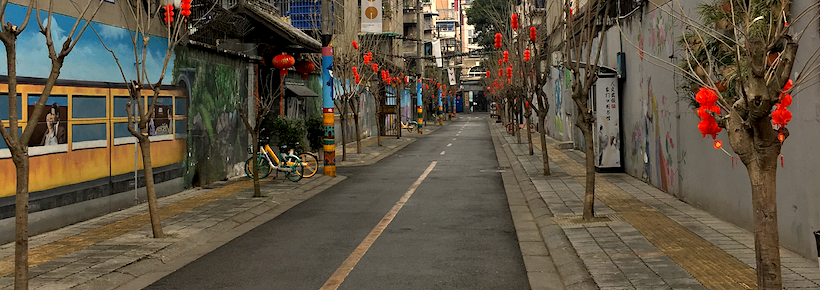
Not long after lunch on the first day of the year of the rat, my fifth-floor neighbor Auntie Cheng bangs on my door. I had promised the previous evening to take her to my gym. We don our N95 respirator masks and set out for the northern end of our neighborhood, where the gym is located.

“It’s important to exercise so that your body can stay strong,” Auntie Cheng reflects as we walk by familiar shops, all closed. The Wuhan coronavirus has put a dent in her family’s new year celebrations. The whole extended family had gathered for a feast the previous night, but the first days of the new year will be spent apart.

There is a feeling in the air that it’s best – maybe even patriotic – not to go out. I am in a group chat with the former security guards from my compound. Earlier that morning Mr. Liao had forwarded a meme in the form of a short didactic poem:

     The country is in a muddle, so let’s not cause trouble
     Make your contribution by staying at home.
     Relatives aren’t going anywhere
     next year they’ll still be here...

Dispatches

They Shut Down the City

A dispatch from quarantined Wuhan during the coronavirus epidemic – Xiaoyu Lu, trans. Allen Young

On January 17, I went to pick up a friend at the Hankou train station in my hometown Wuhan. She was the only one wearing a face mask. At the time, the official line was that everything was under control, that the spread could be prevented. “The Huanan Seafood Market is only two blocks away,” I said to her, teasingly. In an all-night restaurant, the glass tanks were swimming with life. We ate noodles with crab legs. The streets were as packed as ever, with drunk revelers trying to call cabs after their year-end company parties. A man doubled over to vomit, while a young woman patted him on the back and said, “Ready for another round, honey?”

A week ago the panic was still confined to health-conscious retirees, who always worry about seasonal illnesses. It didn’t prompt them to wear face masks or use hand sanitizer more regularly, it just gave them a new reason to get on young people’s case: don’t go out, drink plenty of water. There were also the perennial conspiracy theorists, who doubted official news yet didn’t provide more reliable information. To most of us, not wearing a mask seemed reasonable and logical. After all, who wanted to be associated with paranoid old folks and crackpots?

Photography

Second-Tier China

A photography essay from the urban peripheries – Rian Dundon

*From Changsha by Rian Dundon*

The most banal clichés attached to China describe it as unknown, inaccessible, remote and exotic. But the world of second-tier cities, small towns, and villages in Rian Dundon’s Changsha is unknown not because it is inaccessible or remote, but because no one has thought to look; not because it is exotic, but because it is full of ordinary people piecing together lives in a vibrant, scarred, unstable social landscape.  Dundon’s subject is provincial China, far from the glittering and more familiar scenes of Beijing, Shanghai, and other coastal cities. The world he makes visible is neither the mainline east coast success story, nor the rural left-behind story, nor even the hidden-scenic-China story.  It is something else altogether – people in marginal but not isolated places, aware of a world beyond their experience but reworking and inventing local versions of it according to their own imaginations and desires, constrained by material difficulties but in no way intimidated by their status as citizens of a purported backwater.

Reviews

The Real Lives of China’s Eunuchs

Jeremiah Jenne reviews two books that humanize a much-maligned group

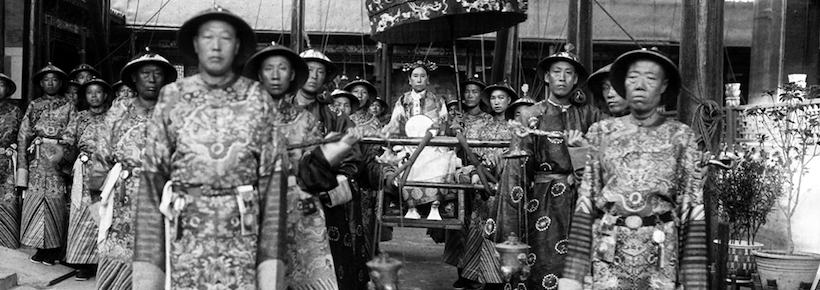
In 1995, an elderly man in a wheelchair visited the Forbidden City. Entering through the northern Gate of Divine Prowess (神武门 shenwumen), 93-year-old Sun Yaoting began giving his helpers a tour of the back garden and courtyards of Beijing’s Palace Museum. There was the doorway threshold removed to make way for the last emperor Puyi’s bicycle. In another yard, two brass rings still embedded in an old tree were part of a long-removed swing once beloved by Puyi’s empress Wanrong. The man in the wheelchair was Sun Yaoting, and he was no ordinary tourist but a former resident returning to his place of employment. Sun Yaoting was China’s last living imperial eunuch.

History has been cruel to China’s eunuchs. Chinese literature is filled with stories of avaricious and ambitious eunuchs exploiting their position for personal gain and power to the detriment of the social and political order. Society treated eunuchs with a mix of fascination and revulsion. They were a source of anxiety for the court and its officials. They were third-sex creatures marked by their relative lack of facial hair and perceived physical deformities (early castration often resulted in eunuchs being taller, with longer hands and limbs). In the foreign gaze, eunuchs became an analog for a decrepit China, feminine symbols of a decaying imperial system – a view perpetuated by 20th-century Chinese reformers and revolutionaries. Today, when thought of at all, it is as stock villains or comic foils in palace costume dramas.