
Audio

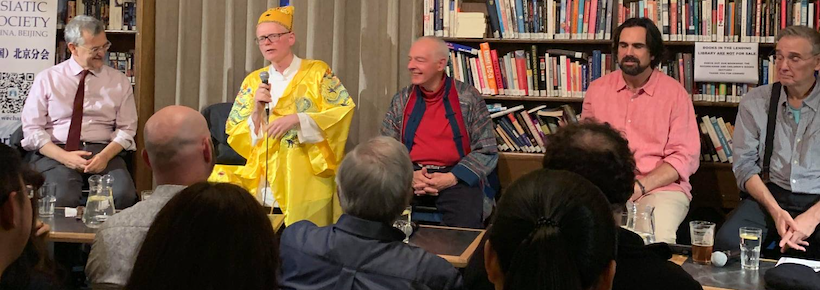
Bookworm Debates: Ming v Qing

A clash of two dynasties at the Beijing Bookworm

At the China Channel we were saddened to hear of the closure of the Beijing Bookworm, a bookshop and events space at the heart of Beijing’s literary scene since 2002, which is now the latest victim of a cultural clean-up campaign in the capital. To remember this purveyor of knoweldge – and wish it luck in its next incarnation – we’re running a few recordings of their events, beginning with the last debate they hosted, on Sunday 10th November. Organised by the Royal Asiatic Society of Beijing, this debate – also syndicated on Sinica – pits journalists Ian Johnson and Francesco Sisci, on the side of the Ming dynsasty, against historians Michael Aldrich and Jeremiah Jenne for the Qing. A dynastial bout for the ages! Enjoy:


Q&A

Writing Between Two Languages

An interview with Chinese novelist Xie Hong – Sun Jicheng

Ed: Xie Hong is an award-winning Chinese author and poet, currently living in Shenzhen. Originally from Guangzhou, he graduated from East China Normal University with an economics degree, then studied English at the Waikato Institute of Technology in New Zealand. He began writing poetry in 1985, but turned his attention to prose fiction in 1993. His first English novel, Mao’s Town, was published in 2018, recounting the effects of the Mao era on a small Chinese town as seen through the eyes of a small boy. His translator, Sun Jicheng, talked to Xie Hong (in Chinese) for us about his life and work.

Sun Jicheng: You are one of the few Chinese novelists who write in English. Why did you decide to write in English?

Xie Hong: It was mainly due to my English-speaking environment. After moving to New Zealand, I decided to study English again, which I had not used for many years. In addition, in 2014, translators such as [yourself] began to translate my short stories to English. Dr. Kong Ruicai, the critic, encouraged me to write in English. He said that there were examples of successful Chinese writers, such as Ha Jin, who did this. At first I thought it was a joke, but then I really tried it.

Essays

Henry Wallace’s Wartime Vision for US-China Relations

A dream of post-war international cooperation that fell by the wayside of history – Matthew Ehret

Some limited moves have been made in the direction of geopolitical cooperation in our troubled age. President Trump has had favorable meetings with the Presidents of Russia and China, followed by a historic visit to North Korea to meet “his friend Kim”. Yet in other respects tensions have never been higher between the US and Eastern powers, as the US-China trade war and Russian interference in American elections leads to further decoupling of West and East. In these times, it is worth revisiting a bygone time in which a leading American political figure embraced a US-Russia-China alliance: Henry A. Wallace, Agricultural Secretary from 1933-1941, and US Vice-President from 1941-1944.

After his government service, Wallace passionately upheld a new vision of the post-war world that included the East. As he wrote in his 1944 book Our Job in the Pacific:

“Today the peoples of the East are on the march. We can date the beginning of that march from 1911 when the revolutionary movement among the Chinese people, inspired by the teachings of Sun Yat-sen, overthrew the Manchu dynasty and established a republic. This was the first time in the vast and culturally rich history of Asia that an Asiatic people turned its back on the whole principle of monarchy and hereditary rule and, in spite of the difficulties and obstacles that still remained, set out courageously toward the attainment of democracy – government of the people, by the people and for the people.”

Reviews

Four Young Chinese Artists, 25 Years On

Richard Kraus looks at two documentaries on Chinese art by Lydia Chen

In her spellbinding 1993 documentary Inner Visions, Lydia Chen interviewed three struggling, idealistic young Chinese artists. Twenty-five years later, the same profilees are back in Chen’s latest film, Art in Smog, to discuss their careers again – this time as mature artists who worked hard to find their places in China’s now prosperous arts scene. Chen’s long-term relationship with them is unique, and makes for two very special documentaries which anyone who cares about the evolution of Chinese art over the past quarter century should watch.

Essays, Reviews

Are the Confucius Institutes a Trojan Horse?

A documentary and an academic roundtable renew the debate – Frank Beyer

The amount of recent news in New Zealand and Australia about China’s influence in the region has been overwhelming. One of the threads, downunder and elsewhere, has been the Confucius Institutes – specifically, whether they are a Trojan Horse for Chinese state influence abroad. A dramatic and accessible entry into this debate is Doris Liu’s film In The Name of Confucius (2017), an exposé on the controversial presence of these Chinese language and culture centres that partner with universities all over the world – based on campus but funded by the Chinese state through the “Office of Chinese Language Council International” known as Hanban, affiliated with the Chinese Ministry of Education.