Excerpts

Beijing’s Last Steel Factory

Jonathan Chatwin visits the abandoned Shougang steelworks

EXCERPTED FROM LONG PEACE STREET

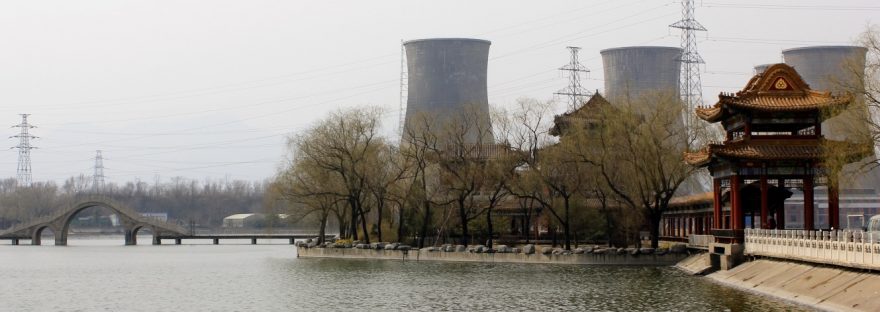
On a sultry August morning, a taxi brought me through Beijing’s western suburbs to the literal end of the road. At a makeshift barrier, a young police officer waved us to a standstill. “You can’t go any further,” he told the taxi driver, glancing pointedly at the foreigner in the back- seat, “It’s a building site beyond here: residents only.” Behind him and the barrier he tended, an almost empty stretch of gloss-black tarmac ran west.

I told the driver I would get out. “Here?” he asked, raising an eyebrow in the rear-view mirror. Here was the very western limit of Beijing, where the frayed edge of the city rubbed against the rough dun stone of the Western Hills. Besides the checkpoint, there was nothing here but a few brick buildings, the forbidden road ahead and the construction site which bordered it, fenced off with blue corrugated iron panels. “Here,” I repeated, proffering my money.
Excerpts

The Dirty DA of Shanghai

US judge Leonard Husar’s sordid judiciary in 1920s Shanghai – Douglas Clark

Milton Purdy, upon arrival as the US Judge in Shanghai at the hearing to welcome him, commented on “how fortunate had been the U.S. Government in getting men of such excellent quality and ability as the officials of this court.” At the very end of 1926, he learnt how wrong he had been. The US Court for China saw the trial of two of its officials for engaging in serious criminal misconduct.

First, Purdy had the sad duty to pass sentence on the former Clerk of the US Court, William Chapman, who had pleaded guilty to embezzling $15,000 from the court. He had originally fled to Seattle, but was caught on arrival in the US and was brought back to Shanghai for trial. Purdy sentenced Chapman to three years and five months imprisonment. Having arrived in Shanghai to be sentenced, Chapman was then put back on the same boat, the President Roosevelt, heading back to Seattle. Long-term US prisoners were now imprisoned at the federal penitentiary on McNeil Island in Puget Sound just near Seattle.

Bangdong

Village Lives

Profiles from China’s changing countryside – Matthew Chitwood

The changes that China’s countryside has witnessed in recent years are unlike anything experienced in any other country during any other time in history. Many cite Shanghai’s iconic Pudong district as a feat of modern development, transformed in just 30 years from empty farmland into futuristic skyline. But to me, the transformation of remote rural China is even more remarkable.

Consider that most rural Chinese grew up in poverty with little or no education. People in their sixties endured unspeakable suffering during times of violent domestic chaos. Most in their fifties never got enough to eat in childhood, and many are illiterate. Those in their forties grew up without electricity, and most in their thirties still remember their village getting its first television set, and completed only junior high school, if that. Now, not only do they all have more than enough to eat, but virtually everyone carries around a mini-computer in his or her pocket.

Reviews

The Thugs of Tiananmen

Grace Jackson reviews Bullets and Opium by Liao Yiwu

“Thugs” was how Hong Kong Police Commissioner Stephen Lo described demonstrators who gathered in historic numbers on June 9 to protest against a bill that would allow for extradition to China, at the outset of a wave of protests that have roiled the city ever since. That word is one of several threads connecting Hong Kong in 2019 to Beijing thirty years earlier. Prior to this year, the last time Hong Kongers took to the streets in such numbers was in solidarity with the student protestors who gathered in Tiananmen Square in 1989. In the aftermath of that democracy movement in Beijing, “thugs” (baotu 暴徒) became a buzzword too. It was the PRC government’s designation for all non-student protestors: the workers, shopkeepers and bystanders who felt compelled to put their bodies between soldiers and students.

Dispatches

Jia Pingwa’s Hometown

How a novelist’s rural inspiration was transformed by his own success  – Dylan Levi King

I was obsessed with Jia Pingwa long before I received the commission to work with Nicky Harman on translating the Chinese author’s late-period novel Qinqiang. I had first come across his most famous early work Ruined City shortly after turning twenty, when a book could still change my life.

Ruined City was published in 1992, but banned the following year for allegedly pornographic content. Even before it was unbanned and republished in 2009 (an English translation by Howard Goldblatt for University of Oklahoma Press finally appeared in 2016), the novel circulated widely in bootleg editions and online. The book tells the story of a horny literatus – Zhuang Zhidie – and his rivals, including Zhou Min, a rusticated upstart who arrives in the city of Xi’an to unseat the literary lion. It was unlike any novel I had ever read: a completely modern work of premillennial Xi’an, full of sexual exploits but borrowing modes and forms from classical epics and Ming vernacular novels. I made my way through Jia’s books that came after, working towards Qinqiang, a rural epic that he published in 2005.