
Reviews

Crossing Borders

Cameron White reviews The Crossing, a new film of Hong Kong

Hong Kong has reached boiling point. In June and early July, millions of young residents took to the streets, protesting a proposed law that would allow extraditions to mainland China. They say the change would undermine One Country, Two Systems, the doctrine supposed to guarantee Hong Kong a high degree of freedom in an otherwise authoritarian country.

One Country, Two Systems was first proposed by Deng Xiaoping as a theoretical model for merging mainland China and Taiwan. The vision: separate legal and economic frameworks could allow disparate regions to coexist within a single, unified China. While never implemented in the context of Taiwan, the model was used to reintegrate Hong Kong in 1997. Since then, perceived violations of that arrangement have been at the heart of nearly every major public demonstration in Hong Kong, including the 2003 protest against national security legislation, the 2012 protest against national education, the 2014 protests against Beijing’s proposed election reform package, and the 2019 protests against the extradition law.

Translation

The Picun Writer’s Group: Part Two

More stories from a migrant workers’ village collective – translated by Jeremy Tiang

This article from One-Way Street Magazine is published in collaboration with Paper Republic. The translation was made possible with support from Sinocism and individual readers via Patreon – donate now to join the effort and help us raise $300 a month to fund more!

Editor’s note: This is the second of two posts (read the first here) that brings stories from the Picun Writers Group, a collective of migrant workers who live in Picun (皮村) on the outskirts of Beijing, into English. The group came to international attention when an essay by one of its members, titled ‘I am Fan Yusu,’ went viral in April 2017 – which Ting Guo writes about here. But there are many other essays, vignettes and poems that the group has produced, which we believe deserve to be read. Here are a few more of them. – Alec Ash

Essays

A Migrant Pen

How Fan Yusu wrote dignity back into migrants’ lives – Ting Guo

In April 2017, an article written by a migrant worker named Fan Yusu went viral on Chinese social media. The piece, titled simply ‘I Am Fan Yusu,’ was published by Beijing-based new media outlet NoonStory and recounts Fan’s family life in a small northern Chinese village, as well as her own story of running away to the southern island province of Hainan, returning home, and becoming a country teacher – all by the age of 12 years old.

Fan goes on to illustrate her present life as a domestic helper in booming, cosmopolitan Beijing. She details how a mistress to the husband she works for begs for his love; how the capital’s migrant children struggle to obtain an education; and how her fellow migrant workers gather together in local reading groups. Many college-educated urban intellectuals and journalists have said they feel “humbled” by Fan’s command of language, her obvious literary talent, and her sharp insight into the marginalized social class to which she belongs.

Photography

Housing Hong Kong

Shek Kip Mei public housing estate in 1965 – Susan Blumberg-Kason

When my grandparents first traveled to Hong Kong in 1965, they visited many of the typical tourist attractions back then: the Peak, the Zoological and Botanical Gardens, and the several floating restaurants spread across the territory. But what struck me most about their slides were the images from the Shek Kip Mei public housing estate.

Excerpts

Déjà Vu in Hong Kong and Shanghai

A tale of two cities – Jeffrey Wasserstrom

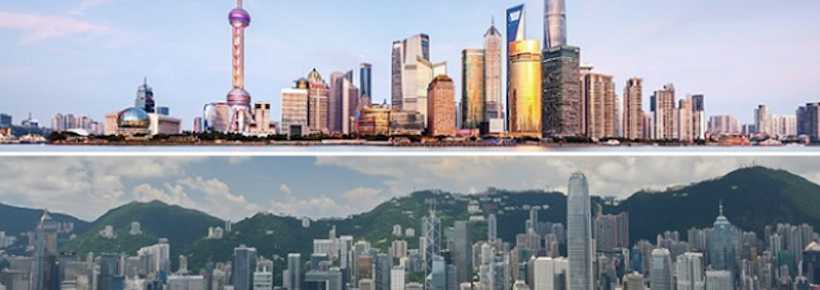
There is a long tradition of treating Shanghai and Hong Kong as comparable cities, albeit ones with distinctive features. This was especially true during the period that followed the Opium War (1839-1842), which ended with a treaty that turned the former into a city divided between a Chinese-run and foreign-run part and the latter into a British colony. Throughout the next century, the two cities vied with each other for the distinction of being considered China’s most cosmopolitan port community and most important gateway to the West. To place them side by side, as I have done in these two vignettes – that while written in the third person, as many readers will have guessed, refer to my own experiences – may seem a much tamer sort of juxtaposition than those found in earlier parts of this book. And yet, the two cities went very different ways after 1949, when Hong Kong remained part of the British Empire and Shanghai became part of the newly created PRC. By the time I first encountered the two cities in the mid-1980s, Shanghai and Hong Kong seemed very different indeed, separated by much more than the hundreds of miles that stood between them. In addition, back then, their campuses and students had little in common.