Little Red Podcast

Post-Umbrella Hong Kong

Post-Umbrella Hong KongLessons, jail and resignation in the wake of the 2014 protests

AN EPISODE OF THE LITTLE RED PODCAST

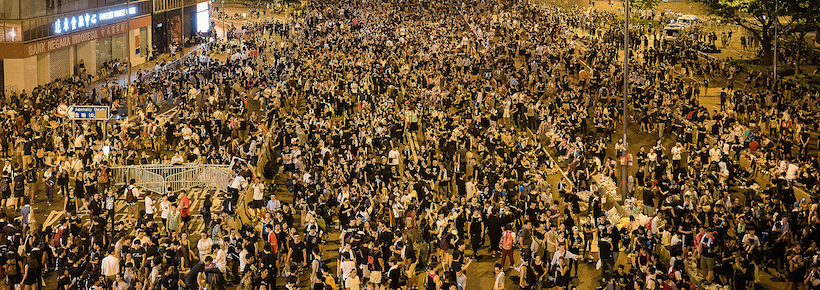
Hate mail, death threats and shadowy surveillance are facts of life for Hong Kong’s pro-democracy activists, five years after the Umbrella movement brought a million people onto the streets calling for greater democracy. Since then, 48 legal cases have been brought against 32 different activists, often on colonial-era public order offences. Louisa and Graeme are joined by two leaders of the Umbrella Movement to talk about jail, democracy and political repression. They are Chan Kinman, one of the co-founders of Occupy Central, who faces a verdict in his trial with eight others on April 8, and Nathan Law, the disqualified lawmaker from the Demosisto Party, who is also one of Hong Kong’s first political prisoners. ∎

Announcements

Help Make More Chinese Voices Heard

Join our translation fund drive by donating on Patreon

Since our launch in fall 2017, the China Channel has published over 400 articles, from book reviews to essays to narrative dispatches. We’ve also featured dozens of original translations of the best contemporary non-fiction, fiction and poetry, bringing new work from Chinese into English for the first time. In doing so, we have worked in partnership with Read Paper Republic, One-Way Street and The Initium, as well as commissioning original pieces – most recently new translations from the Picun Writers Group.

Our translations are funded in part by readers like you on Patreon. Your support allows us to commission Chinese authors as well as translators, so that Chinese writing that would otherwise remain inaccessible can be read by you. We are grateful to all our sponsors for making this happen, in especial Bill Bishop of Sinocism, and to Stephen O. Lesser, who has supported the Diaspora column. To date, 17 readers are currently donating a total of $161 per month. We thank all of these patrons for their continued support.

As we approach our third year, we are again calling on you to help us continue to fund original translations and meet our other commissioning costs. This July, we’re looking to hit our funding goal of $300 per month in contributions via Patreon. That extra $140 is will allow us to commission more translations from both emerging and established authors. If just two dozen of you committed $5 or $10 a month – as more than that did already in our recent reader survey – then we will hit that goal easily.

Diaspora

What We Owe Each Other

Anxiety of influence in writing from the diaspora Jane Shi 

I am afraid of ancestral debt. The debt that does not come in the form of money, though it is often steeped in it. The debt that is not knowing – of how to ask and where or why exactly it hurts. An inheritance that cannot be thrown out, a thing more ceaseless than ocean and more anguished than birds swallowing plastic. 

What is ancestral debt? To whom are we indebted, and how? Over time, as I come into my voice as a Chinese Canadian writer and poet, I learn that the central questions of diaspora are best attended to through metaphor. The movement of a vehicle (ocean, birds) as it reimagines a tenor (inheritance of debt) is much like what happens when bodies migrate across land and water to reimagine belonging. If a poet’s job is to bear witness and reassemble everything that gets tugged away and lost through displacement, what happens when the poet herself houses the memories, stories, and hauntings of that loss? What does she do with images that keep coming back and refuse to let go? 

Essays

Troubling the Surface of Identity

Coming into queerness in the diaspora – M. Huang

While home alone one day, when I was still in secondary school, I happened to channel-flick to E4 and catch the episode of the Canadian show Being Erica that featured Anna Silk as Cassidy Holland. Cassidy was the titular character’s best friend in grad school: we learn that she is gay and had, in 1999, and in keeping with the trope, fallen for her best friend. In one scene, she tells Erica plainly, “I think you are beautiful. I'm really attracted to you. And I know you just want to be friends and that’s cool, but in the spirit of being frank? I have wanted you since the moment we met.” Her eyes are intent and piercing. It must have been 2009, and I didn’t yet have the language to describe or articulate what it was that I was seeing. All I know is that, watching that episode, I felt something, and although I didn’t know it at the time, that something would stay with me.

Diaspora

Queer Finds Family

Cantonese opera ignites LGBTQ voices in Vancouver’s Chinatown – Kimberley Wong 

Editor’s note: To celebrate Pride Month and the 50th anniversary of the Stonewall uprising, this column brings you three stories from queer and LGBT+ diasporic communities over the next three days, beginning with Kimberely Wong’s route back to the art of her grandfather, a master of Cantonese opera. – Rebecca Choong Wilkins

As I stood at the bottom of the stairs at the Wong’s Benevolent Association, I held a plant in one hand, my hand gripped tight to the grainy bottom of the pot, eyes interrogating the leaves, ensuring they were glossy and auspicious-looking. I wanted to make a good impression on the folks I would be meeting today. I had my notebook, with ‘Wong’ written on the front, in the other hand. I had asked my Dad and my Grandma, both born Wongs, to tell me the names of our ancestors and fellow Wong Chinese-Canadians, so that I could look them up in the manifestos and so that I could tell Uncle Tim Wong, the elder Wong historian, to whom I was related. In the scurry of looking through photos of my Yeh-Yeh, my paternal grandfather, we figured that he and Tim Wong must have been in Chinatown at around the same time, in the same social circles.