Essays

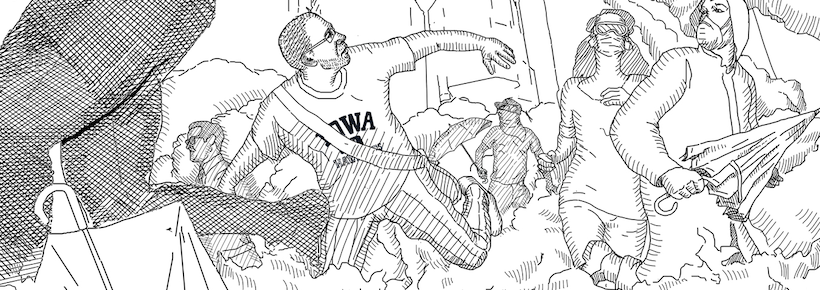
Unpredictable Hong Kong

The perils of prognostication and lessons of history when it comes to Hong Kong’s protests Jeffrey Wasserstrom

How long will the large-scale street actions that began to take place regularly in Hong Kong last June continue? And what kind of development is most likely to bring to an end these protests, which were first triggered by an extradition bill but are now in large part calls for the government to rein in and investigate the police?

I was often asked variations on one or both of these questions during the period lasting from early June until early October of 2019 that I spent writing Vigil: Hong Kong on the Brink (Columbia Global Reports, February 2020). As the length of the struggle went from days to weeks to months, I grew used to either dodging the questions or providing equivocal answers. I continued to do so during the final weeks of 2019 and the first weeks of 2020 – right up until the main questions people asked me shifted, just before Vigil came out, from being about the protests to about the coronavirus. Whether I refused to make any kind of prediction or made a careful one with all sort of caveats and prevarications, I typically began my response to the two questions by making some or all of the following points:

Translation

Qinghe Prison

A short story by Bei Ling, translated by Scott Savitt

It’s afternoon. I’m being transported in a military jeep. On the road I ask the undercover officer: “Where am I being taken?”

“To a hotel,” the plainclothes officer scoffs.

The jeep is speeding down a newly paved freeway in Beijing’s faceless western outskirts.

The jeep slows down and enters a compound surrounded by a towering wall. An electric fence lines the top of the wall, and armed soldiers man the guard towers.

Next to the iron gate is a sign that says: Qinghe Prison.

I feel like an explosion has gone off in my head.

I am escorted into the detention center’s office. As soon as I get inside, a prison guard snatches my glasses.

Without my glasses I am half-blind. I start to protest, but the guard kicks me and shouts: “Squat down and get your hands behind your head!”

I dodge the brunt of his blow, and start to say: “Please don’t hit me….” when he kicks me again, this time much harder, sending me staggering into the corner of the room.

The plainclothesman that escorted me here says with a laugh: “Did you really think you were going to a hotel? You might be alive when you arrive here, but there is no guarantee that you won’t leave a corpse!”

Essays

Time-Traveling with Your Uncle Gem

Wujun Ke introduces “Dongbei vaporwave”, the retro electronic rap of China's northeast

When a friend introduced me to the Chinese viral hit “Ye Lang Disco” (“Wild Wolf Disco”) in September last year, I was not sure what the hype was about. Then, like thousands of internet commentators, I fell victim to the earworm. I was captivated by the song’s refreshingly folksy and unassuming sense of humor. Gem (董寶石), a rapper from Changchun, performed the song in the 2019 season of Rap of China, a popular televised rap competition. Soon after, Gem found breakout success on Tik Tok (known in China as “Douyin”) with a vaporwave-influenced track. 

Reviews

The Life of Laowai

Quincy Carroll reviews An American Bum in China by Tom Carter

A common explanation for the dearth of quality fiction set in modern China is that nothing invented by the mind of a foreigner could ever compare to the everyday stories out in the streets. China is complex, dynamic, at times bewildering, and in the 18 years since the release of Peter Hessler’s River Town, global audiences have exhibited a sustained appetite for factual, firsthand accounts of life in the Middle Kingdom. During that same time, many writers have tossed their hats into the ring to varying degrees of success. Yet there has been a noticeable lack of attention paid to what some might argue is the most curious subject of all in China: the laowai or foreigner living there. This is by no means an appeal for more navel-gazing memoirs about Asia as seen through the eyes of the West, but rather a call for more stories critically examining the attitudes and motivations of those who have come to make China their home. Tom Carter’s recent work, An American Bum in China, a true-to-life account of Iowan Matthew Evans’s “bumblingly brilliant escapades” from Guangdong to Shanghai to Yunnan to Hong Kong, tackles these themes head-on, and upon reading, even the most ardent defenders of fiction will be forced to admit: you just can’t make this stuff up.

Dispatches

How the Chinese Diaspora is Changing Laos

Juliet Lu and Wanjing Chen explore the impacts of the Belt and Road in Laos

There is something about China – perhaps it’s size, perhaps it’s foreignness to Western audiences, or perhaps the simple fact that it is a new global economic power – that lends to vast oversimplifications and doomsday portrayals of the country’s global integration. China’s increasing presence overseas is one of the topics on which this oversimplification gets the most play. Summary statistics and breathless reports give the sense that Chinese firms parachute into countries, checks in hand, and unilaterally determine what to build, grow, and extract. But in order to understand how China’s global integration is unfolding on the ground, we need to ask a few questions. How does this emerging wave of investment actually take root on the ground? Through what channels does Chinese money flow, and through whose hands?