Bangdong

A Day in the Life of Rural China

Tea pickers and country medicine in farflung Yunnan – Matthew Chitwood

Bangdong village, Yunnan – Wo-wo! Wo-wo-wo-wo-wo! The cock-a-doodle-doos of Chinese roosters echo across the mountainsides as Li Guojun rises in the dark. He limps up a hillside to his flock and tosses out handfuls of corn. The delicate light in the eastern sky warms to a rich orange until it spills over the horizon and rolls down the blue mountains toward the Mekong River. The roosters intensify their crowing. Although there are few constants in this remote village in southwest China, this morning chorus is a daily certainty. So too is Li Guojun’s morning routine. He hacks down a banana palm with his machete and shoulders it back home. It will be dinner for his cattle.

Li Guojun is a cowherd. Every day for the last 15 years, he has led a dozen or so cattle down into the valley to drink from the cool streams that flow into the Mekong. And every evening he brings them home to eat banana palm in his stable. Today will be no exception.
General

Support the China Channel’s Future for Christmas

A year of anniversaries for China has passed, and the China Channel celebrates its third year as we break for Christmas. We’d like to take this opportunity to ask you to support our future by donating – however small an amount – on Patreon. Whereas we have been funded by grants in the past, we rely on your support to directly fund our translations of Chinese essays and stories into English. The money that you give is set aside and goes expressly for this purpose; all those small gifts tot up to pay translators, authors and publishing partners we work with, so as to bring writings into English that would not otherwise be possible to read.

We won’t keep asking after this, promise. But do consider donating the price of a pint this holiday season to bring Chinese voices to a wider readership (and if any generous souls want to support at a higher level to fund the future of the site as a whole, feel free to reach out directly.) Below is a selection of a dozen translations we have published over the last year, funded by your generosity, for which we thank you. – The Editors

Listicles

20 China books to read (and 5 to avoid)

Essential reads for your China library

'Tis the season of merriment and listicles. Before we break for Christmas, we've updated our list of essential China books, in case our latest staff picks weren't enough for you. We’ve split this into five lists of five: books on contemporary China; books on Chinese history; books from Chinese voices; Chinese classics; and a new fifth section, China books to avoid. (We don't mean that these books have no value – they are all informative – but that they are ultimately misleading and so you should avoid them in favour of others.)

We hope this is useful as an open sesame for new China watchers, or for old China hands to plug holes in their bookshelf. The lists are designed as all-you-need to pack your bag/Kindle to grasp that aspect or perspective of China, without being overwhelming. Naturally, we have missed out a plethora of wonderful books. But, we hope, this is only the beginning of your reading. See also our lists of 12 must-read Chinese fiction books, and a dozen Chinese films to watch.

Staff Picks

Christmas Staff Picks

It’s not too late for some last minute Christmas shopping – so the editors of the China Channel are stepping in with the third installment of our winter staff picks. From books to films to music and audiobooks, these recommendations are of the overlooked fringes of Chinese society – junk, gangsters, domestic workers, Turkic beats – and so not your traditional festive fare. But who needs It’s a Wonderful Life when you can watch a slapstick Sino-Russo romcom instead?  – The Editors

Recommended by Jeff Wasserstrom (founder):
Secondhand: Travels in the New Global Garage Sale, by Adam Minter

I’ll begin this recommendation with a disclosure and a confession. The disclosure: Adam Minter is a friend whom I have enjoyed meeting up with and talking to about China since the scrap metal beat, of all things, took him to Shanghai about a decade ago. The confession: I’ve only had the chance so far to read the first part of his second book. There are three reasons, though, while I still feel confident suggesting Secondhand as a gift. One: it is written in the same unpretentious yet informative, personal yet knowledgeable style as his debut book. Two: that first book, Junkyard Planet, on a similar topic of China’s trash and recycling, was excellent. Third: while blurbs should always be taken with a grain of salt, climate-change writer Elizabeth Kolbert’s endorsement speaks volumes: “Minter’s travels through the afterlife of stuff are revelatory, terrifying, but ultimately hopeful.”

Essays

Hong Kong’s Sickness

Hong Kong writer Hon Lai-chu on a city dividedtrans. Andrea Lingenfelter

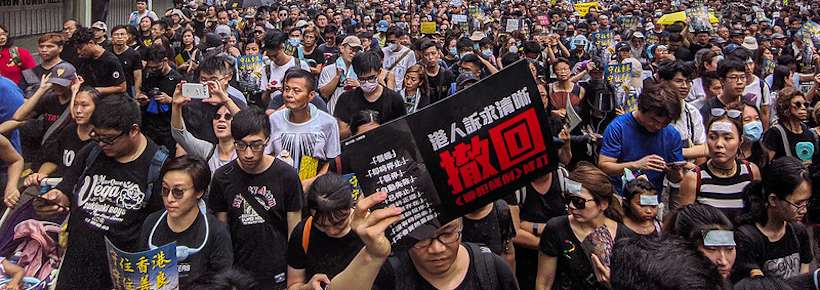
Translator’s note: Hon Lai Chu, an award-winning writer from Hong Kong, wrote this essay at the end of August. At that time, her neighborhood of Tsuen Wan was the scene of violent clashes between police and demonstrators. In early September, Hong Kong’s Chief Executive Carrie Lam announced that the extradition bill that initially sparked the protests would be withdrawn, yet the gesture was seen as too little too late, and it was not until October 23 that the bill was formally withdrawn. Demonstrations continued, and the situation has become increasingly volatile, with Polytechnic University under siege in mid November, and a December 8 march drawing an estimated 800,000 participants.

In her essay, Hon Lai Chu writes of the loss of public trust, and references one of Hong Kong’s formerly most beloved and reliable institutions, the MTR metro system, which has periodically closed stations to make it more difficult for people to reach demonstrations. There have also been numerous documented instances of police brutality, as well as organized attacks on protesters by members of organized crime, while police have turned a blind eye. As Hon Lai Chu observes, like teargas residue (which left this writer with a headache and watery eyes after a brief visit to a shopping mall in Mongkok), the after-effects of this conflict will linger long after the crisis has been resolved. – Andrea Lingenfelter

Hong Kong these days is like a body afflicted with a malignant tumor: the mind is unwilling to acknowledge the tumor’s existence and only wants to clean up the annoying but superficial daily signs of disease; yet the heart is plagued by unease. Illness is an ongoing struggle in the body, and only a healthy person has the strength to withstand the battle between good cells and bad cells. Whether we’re talking about one person or an entire city, a bout of sickness represents an opportunity for deeply seated problems to be cured. Although a body that has never known illness may continue to function normally, when toxins accumulate and cannot be easily expelled, the condition can be fatal.