Hidden History

The Refugee Emperor

How the Yongli Emperor was strangled in Kunming by a turncoat general – Jeremiah Jenne

Even researching a column titled Hidden History, this was getting to be a bit much.

Our impromptu guide in Kunming, capital of China’s mountainous southwest province of Yunnan, led us past a police guard post, into an underground garage, up three flights of stairs, through a pediatric hospital, and then out the lobby of what looked like the emergency room. “Turn left; it’s right there.”

And there it was: A stone tablet set slightly back in a small urban park, complete with exercise equipment and a signboard reminding us to “Learn from Lei Feng.” Inscribed on the stone in slightly faded red letters: “The site where Emperor Yongli of the Ming (1623-1668) gave his life for his country.” It was on this spot in 1661 that the last claimant to the throne of the Ming Dynasty was strangled to death by his captor, Wu Sangui (1612-1678).

Chinese Corner

At Dim Sum, Don’t Forget the Tea

Rosalyn Shih tells us what to pair with the classic Cantonese cuisine

When Hong Kong locals invite you out, they never say, "Let's go for a beer." Instead they “treat you to drinking tea” (cing2 nei5 jam2 caa4 請你飲茶).What they really mean is that they’re taking you to dim sum (dim2 sam1 點心).

The Cantonese phrase jam2 caa4 飲茶 or “to drink tea” – not to be confused with the Mandarin phrase hē chá 喝茶, a euphemism for being interrogated by the police – is synonymous with having dim sum. Although Hong Kongers emulate the global cosmopolitan by preferring chilled water at Western restaurants, they still require lots of hot tea to help the BBQ pork buns go down and aid the digestion of fried spring rolls. There is probably nothing I associate more with Hong Kong than the smells of starchy tablecloths and the earthy brew of pou2 lei5 普洱 – commonly known by its Mandarin name pǔ'ěr – floating over the din of family friends enthusiastically shouting at each other across tables.

Q&A

Thrilling Cities, Hearts of Glass

Susan Blumberg-Kason interviews Ivy Ngeow about her new Macau-noir novel

You write about early 1980s Macau. Not only has there been little set in Macau in terms of fiction, but that period is also special since it’s during the early days of development. How did you research that period?

I found a very old book by Ian Fleming called Thrilling Cities (1963) in Chowrasta Market in Penang, Malaysia, whose strapline was “Ian Fleming, creator of James Bond, takes you on an offbeat tour of the flesh pots of Far Asia and America.” It had fascinating, lurid, sexy black-and-white photographs of “thrilling cities” which included Chicago and Macau in the golden days of the 1950s and 1960s.

Excerpts

Damming the Upper Mekong

How new dams in southwest China are displacing upland peoples – Brian Eyler

An excerpt from Last Days of the Mighty Mekong


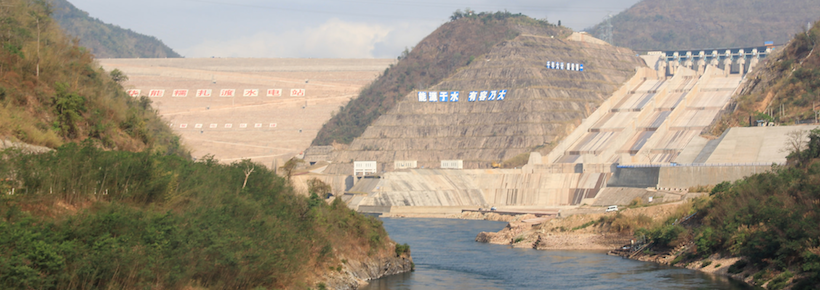
Just south of where the stream draining the Yubeng Valley flows into the Mekong, the river cuts sharply through a series of steep S-shaped canyons. A few years ago, the dirt path along the river’s eastern side was paved into a new highway. The road is most traveled by Tibetans on motorcycles or oversized dump trucks hauling minerals and sand from local mines and quarries. Small Tibetan villages of 30 or 40 homes made of stone, wood and sod cling to the hospitable parts of the canyon’s few terraces. Multi-colored prayer flags connect each red-roofed home to the local temple or Buddhist shrine. Sometimes the ends of these lines disappear high into the mountainside. Halfway up the canyon, the occasional white stupa keeps watch over these villages. Simple suspension bridges, sturdy enough only for pedestrian or motorcycle traffic, span the river. Not all villages on the opposite side of the canyon have bridge access, and their residents must travel a few kilometers downstream to the next village to reach the paved road.

Essays

The American Spirit behind China’s New Silk Road

US-Chinese cooperation and the dream of a global railroad – Matthew Ehret

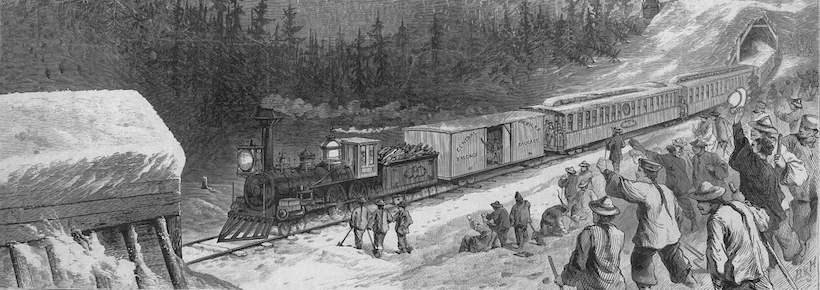
Until recently, the Chinese role in building America’s transcontinental railway was nearly written out of history. It was only in 2014 that the US Department of Labor inducted the Chinese railway workers into the Hall of Honor, officially recognizing for the first time the vital role and sacrifice of the Chinese, whose numbers amounted to over 15,000 workers at the peak of the project’s construction – 90% of the total Central Pacific Railway workforce.