
Dispatches

Chinese Burners

China goes to Burning Man, and reinvents it at home – Ian Rowen

Science-fiction author Chen Qiufan recently published an account in Logic magazine of his virgin trip to Burning Man in 2018 as a “Chinese burner.” Chinese tech entrepreneurs, he writes, “act as the first generation of pioneers journeying into the virtual New World. They imagine themselves as packs of wolves in the Mongolian plains who can only survive and emerge victorious through bloody combat, incessantly stalking new territory and prey.” Reflecting on their pursuit of success and power amidst all the surreal art and spectacle, Chen concluded that his tech-networking campmates’ “combination of worshipping totems while pursuing practical benefits is quintessentially Chinese.” Alas, it’s also quintessentially American – as in the myth of the Western frontier – and Burning Man may be the world’s most weirdly scenic place to watch this collision of financial and imperial fantasy.
Dispatches

China’s Anime and Cosplay Obsession

How the rise of “2D culture” helps Chinese teenagers escape pressure and find purpose – Tanner Greer

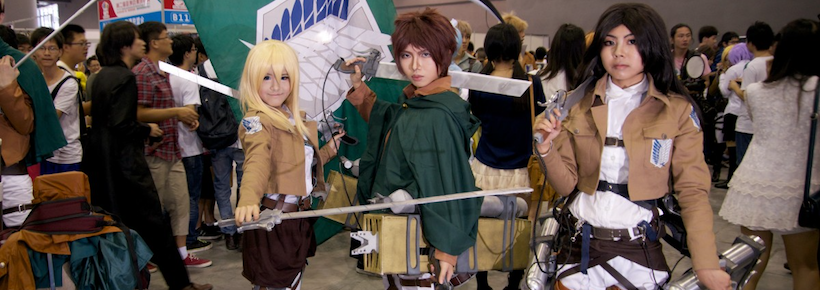
“Most people have no idea I do this,” said Wu Na, beaming, as costumed conference-goers stopped to take her picture. The 14-year-old was wearing a thin cotton cloak over a knee-length tunic. As I talked to her, a boy walked into the convention hall sporting spiked hair, a neon-purple trench coat, and a bare chest. Like the hundreds of other cosplaying teenagers in the convention hall, he was not going to allow Beijing’s frigid January temperatures to cramp his style. “I have trouble connecting with most other people at school,” Wu reflected. “But in the two-dimensional world there is a sense of community I can’t find anywhere else. My second-dimension friends mean so much more to me than my third-dimension friends do.”

Wu is just one of the hundreds of millions wrapped up in what young Chinese call the “second dimension” (二次元). The closest English parallel is the ACG, or animation-comic-gaming sector, the market’s favorite acronym for a certain class of Japanese pop culture exports: anime, manga, and the merchandise inspired by them. The two-dimensional world Chinese teenagers such as Wu Na live in includes all of these elements, but their self-styled “second dimension” extends further – and is not limited to Japanese ACG, also factoring in anime-styled cartoons drawn in Korea, China and the United States.

Dispatches, Translation

A Foreigner in Beijing

Reflections of a returnee – Liuyu Ivy Chen

When I arrived in Beijing in January, I paused on the sidewalk and looked up: the sky was blue, cloudless, immense. I went to college in this city, and often visited after graduation. Back then, Beijing’s sky was typically a murky palette, a mix of smog, dust and sand from carbon emissions, courtyard demolitions, subway construction and northwestern storms. I soon learned that the government had shut down the city’s coal-burning heating systems during a recent eviction campaign which targeted low-skilled migrants. This controversial operation was vaguely documented in the Chinese media, but its result was clearly reflected on the sky.

Dispatches

Checkpoint Nation

Navigating security checks in the Uyghur homeland – Darren Byler

On a visit in April 2018 to the Uyghur homeland in Northwest China, I was amazed by the number of checkpoints that turn every city and town into a maze of ethno-racial profiling and ID scans. In some areas, the checkpoints are every several hundred meters. The checkpoints are only for those who pass as Uyghur. Han folks and obvious foreigners are usually directed to walk through the exits of the checkpoints with the wave of a hand. The checkpoints are not for them.

Since 2009 there have been a number of large-scale violent incidents involving Uyghurs, state security and Han Chinese civilians. Since 2014 the state has conducted a so-called People’s War on Terror that has subjected Uyghurs between the ages of 15-45 to intense scrutiny. As a result of this campaign, the state has detained hundreds of thousands of young Uyghurs in a re-education camp system while radically increasing the police presence.

Dispatches

Mining the Zeitgeist

Thomas Bird excavates the Lianzhou photography festival

I follow the map on my phone as it leads me into the backstreets of Songzhuang Art Colony, the world’s largest art village, located on the eastern fringe of the Beijing municipality. Just when I think I’ve been lured into a labyrinthine trap, the unmistakable bald head of Shanxi-native Luo Dawei (罗大卫) emerges from a doorway and beckons me in from the cold.

“Sorry about the mess, we’re just moving in,” he says as I watch computers and office furniture being delivered, unpacked in a tempest of cardboard and dust.