Essays

Something in the Air

Geremie R. Barmé on a Maoist education, and Tiananmen remembered

Tōutīng dítái!

偷听敌台!

The gruff voice barked over the cement trough. I was in the washroom of our dorm building at the Beijing Foreign Languages Institute. He was a Worker Peasant Soldier Study Officer 工农兵学员 (the Maoist term for ‘student’) wearing, even at that darkling hour in the morning, a high-collar blue Mao jacket. Steely faced, his tone was that of warning and accusation. I had no idea that he'd just said:

'You're furtively listening to enemy broadcasts!'

Essays

Double Dissidents

The cognitive dissonance of overseas Chinese students – Xiaoyu Lu

“Why were you defending an authoritarian regime?”

Tina, a friend from Comparative Politics class, asked me this as we walked out of the seminar room. We had began our graduate course at Oxford three years ago, and both carried on with doctoral research in Politics. Despite the occasional hostilities between our home countries (China and the US), we quickly became close friends and suspended the ideological differences between us. Still, her question left me half shocked and half puzzled. During the past two hours, we had been debating furiously about the “doomed future of democratization” and the “crisis of liberal democracy.” As usual, I was critical of mainstream political thought, especially any definition of democracy that delimits itself to a few institutional yardsticks, along with a tone of moral proselytism that renders democracy as a dividing battle between us and them.

Essays

From History to Fiction

Dung Kai-cheung on inventing Hong Kong stories

History is not fiction, nor fiction history. The two are not the same thing, or else we do not need two different words, two different notions. It is dangerous to confuse them. Yet, history and fiction are closely related.

In a narrow sense, where facts are verifiable, we have to defend history from fiction. The Holocaust and the Nanking Massacre are two of the most obvious cases. But in a broader sense, things don’t seem so clear-cut. Historians do their best to verify the facts, but nearly always facts do not exist by themselves. What we have instead are documentation and testimonies, which are seldom without inadequacies or biases. Then comes the necessary step of interpretation, the area where historians excel at contending with one another, individually or as representatives of political or ideological perspectives. In principle, the line between facts, documentation and interpretation may still be drawn to a certain extent, but in fact the gradation is often blurred or the division has become hardly discernible. As the late British historian Eric Hobsbawm has repeatedly argued, national histories are invariably inventions of traditions. The result is that we simply take the interpretation or inventions as the facts themselves. It is in this sense that we may call history fiction.

Essays

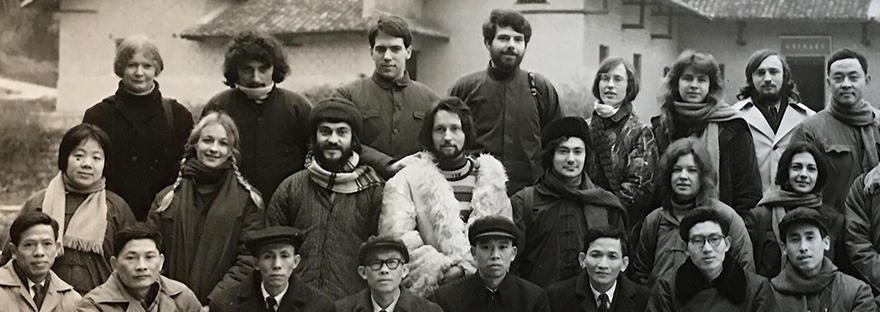
When Malaparte Met Mao

Anatomy of a fellow traveller – Frank Beyer

In 1956 the Italian novelist, Curzio Malaparte, received an invitation to travel to Beijing for a commemoration of the death of writer Lu Xun. Malaparte is most famous for his quasi-surrealist WWII novels, Kaputt and La Pelle (The Skin). In Kaputt, as a journalist and officer in the Italian army, he narrates what happened behind the Eastern Front. Episodes from Ukraine, Finland, Romania and Poland get us up close and personal with, amongst others, members of the Nazi elite. Malaparte seems to revel in the horrific subject matter, showing the abuses and hypocrisies of the Axis forces like no other. In The Skin he is a liaison officer attached to the American army, taking us on a Dantesque tour of the hell that is Naples after Allied liberation. He exposes the naivety of the Americans and the damage done to the already miserable local population.

Malaparte was a keen observer, who did not shy away from making criticisms. Why then, on his trip to China, was he so charmed by everything? Did he leave his critical faculties back in Europe?

Essays

Shedding Light on Shadow Banking

Demystifying the commoner’s financier – Mary Davis

Shadow banking has a bad reputation the world over, but particularly in China. Major media outlets and economists alike have demonized it, casting their black mark of economic imbalance across all faux-banking operations throughout the country. But what if they were not the evil shark-loaning, wobbly institutions that we’ve been made to believe? What if they were helpful more than harmful?

This was the opinion of one Chinese banker who left his job as deputy head of Investment Banking at UBS to become a shadow banker in 2011. After moving to the "dark side,” Joe Zhang ended up publishing a book on his experiences, Inside China's Shadow Banking, in which he described the greater opinion of shadow bankers in China to be “only slightly more respectable than perhaps massage parlors or nightclubs.”