
China Conversations

Stephen Platt on Becoming a Historian of China

In conversation with Jonathan Chatwin

Stephen R. Platt is an American historian and writer. He is a professor of Chinese history at the University of Massachusetts Amherst, and holds a PhD in Chinese history from Yale University. He is the author of three books of Chinese history: Provincial Patriots centred on the Hunanese, Autumn in the Heavenly Kingdom on the Taiping rebellion, and Imperial Twilight about the Opium Wars. Jonathan Chatwin talked to him about his path into Chinese history, his tips for researchers, and the challenges involved in bringing the past to life.

Can you tell us about how you became interested in Chinese history?

It was something of an accident, actually. When I graduated from college I got a fellowship to teach English for two years in Changsha, the capital of Hunan Province. It wasn’t something I had planned in advance – I had never studied Chinese before, or taken any classes on the country’s history, but it seemed like an adventure. It was a powerful experience. I got hooked and decided to keep studying the language after I came home. In graduate school I migrated from English (which had been my undergrad major) to East Asian Studies, and then finally to Chinese History. This is probably the last thing my younger self could have imagined I would be doing at this age. As I see it, much of my work has touched on themes of travel and culture shock that date back to that post-college experience of finding a place for myself as an American in China.

Reviews

The Personal over the Political

Jia Zhangke scales down in his new film – Amanda Walencewicz

Jia Zhangke, whose cinema has been acclaimed for its social criticism of contemporary China, is contemplating his own oeuvre. The Chinese director’s latest film, Ash is Purest White – which premiered at Cannes in 2018 and was released in the US this March – is sprinkled with references to his previous work. A member of the so-called “sixth generation” of Chinese filmmakers (those born during the Cultural Revolution, now in their fifties), Jia has been making independent features since the mid-1990s, and 1997’s Xiao Wu – about a small-town pickpocket – established him on the global film scene. A former breakdancer from the northeastern city of Fenyang and a graduate of the Beijing Film Academy, Jia’s films have focused on his generation and their milieu, recreating their lives with documentary-like fidelity.

Q&A

The Golden Age

In conversation with speculative novelist Chan Koonchung

You came up with the idea for your novel in 2008. Why set it five years later?

In 2008, I realized something significant had happened to China’s perspective of itself and the world’s perception of China. I thought I had a story. I call it “the new normal.” The title of The Fat Years in Chinese is Sheng Shi (盛世), which means the golden years of ascendency and prosperity. This phrase was not used to describe China for at least a century and a half. Now, suddenly everyone is using sheng shi to describe China.

But as I started writing the book in 2009, my intellectual friends in Beijing didn’t agree – they didn’t feel that China was entering an age of ascendency. They emphasised the dark side of China. I wanted to write about what was happening before my eyes, but I didn’t feel my writer friends would agree. So I set it in the not-too-distant future, 2013, so I could come up with fictional events to describe my view of what was happening. In fact, it’s all about the present.

Translation

The Smog Society

Science fiction by Chen Qiufan – translated by Carmen Yiling Yan and Ken Liu

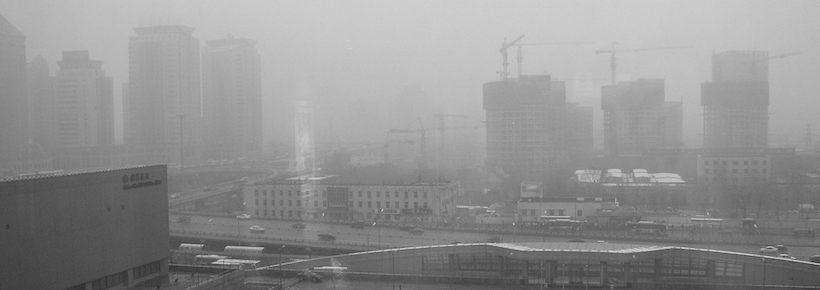
Lao Sun lived on the 17th floor facing the open street, nothing between him and the sky. If he woke in the morning to darkness, it was the smog's doing for sure.

Through the murky air outside the window, he had to squint to see the tall buildings silhouetted against the yellow-gray background like a sandy-colored relief print. The cars on the road all had their high beams on and their horns blaring, crammed one against the other at the intersection into one big mess. You couldn't tell where heaven and earth met, and you couldn't tell apart the people, either. Passels of pedestrians, dusty-faced under filter masks that made them look like pig-faced monstrosities, walked past the jammed cars.

Translation

The Storytelling Robot

Fantastical sci-fi by Fei Dao – translated by Alec Ash

Once upon a time, there was a King, who loved neither the beauty of his domain nor its women, but only took pleasure in listening to stories. He kept a storyteller in his palace, but the number of tales that any one person can know is limited, and whenever a minstrel had told them all the King would exile him far, far away. After a while, no one dared tell any story.

And so the King convened the most ingenious scientists in the land, and ordered them to build a storytelling robot. At first, the stories that the robot told were lifeless, but it had the ability to learn independently, and under the supervision of the scientists it slowly perfected the quality. Its brain was installed with every story that was known of, and each night the King, tired from the affairs of state and wanting to relax, ordered the robot to spin him a yarn. If the King could not hear two or three short stories before retiring, he was not able not sleep.